If you live in Jeddah (whether you grew up here or moved for work) your daily routine probably includes three of the most staining things you can put against your teeth: Saudi coffee with cardamom, sweetened black tea, and heavily pigmented spices and foods. Add the smoking that’s still common across the Western Region, plus the kind of dry, hot weather that pushes most people toward sugary cold drinks, and you have a recipe for the gradual yellowing that brings most patients into a dental clinic in the first place.
The instinct, for a lot of people, is to handle it at home first. A jar of baking soda costs less than 5 SAR at any supermarket. Lemons are sitting on the counter. There’s a YouTube video promising results in a week. Why pay for professional teeth whitening in Jeddah when the internet swears the same effect is sitting in the kitchen?
The short answer: some home methods do a little, some do nothing. One of the most popular combinations baking soda and lemon for teeth can significantly damage enamel over time.Baking soda and lemon for teeth — is actively damaging your enamel in a way that isn’t reversible. This guide explains what’s safe, what isn’t, and when it makes sense to skip the experiments and book a proper session at Tam Dental’s whitening clinic.
How tooth staining actually works
Before any whitening method makes sense, it helps to know what’s being whitened. Tooth discoloration comes in two layers.
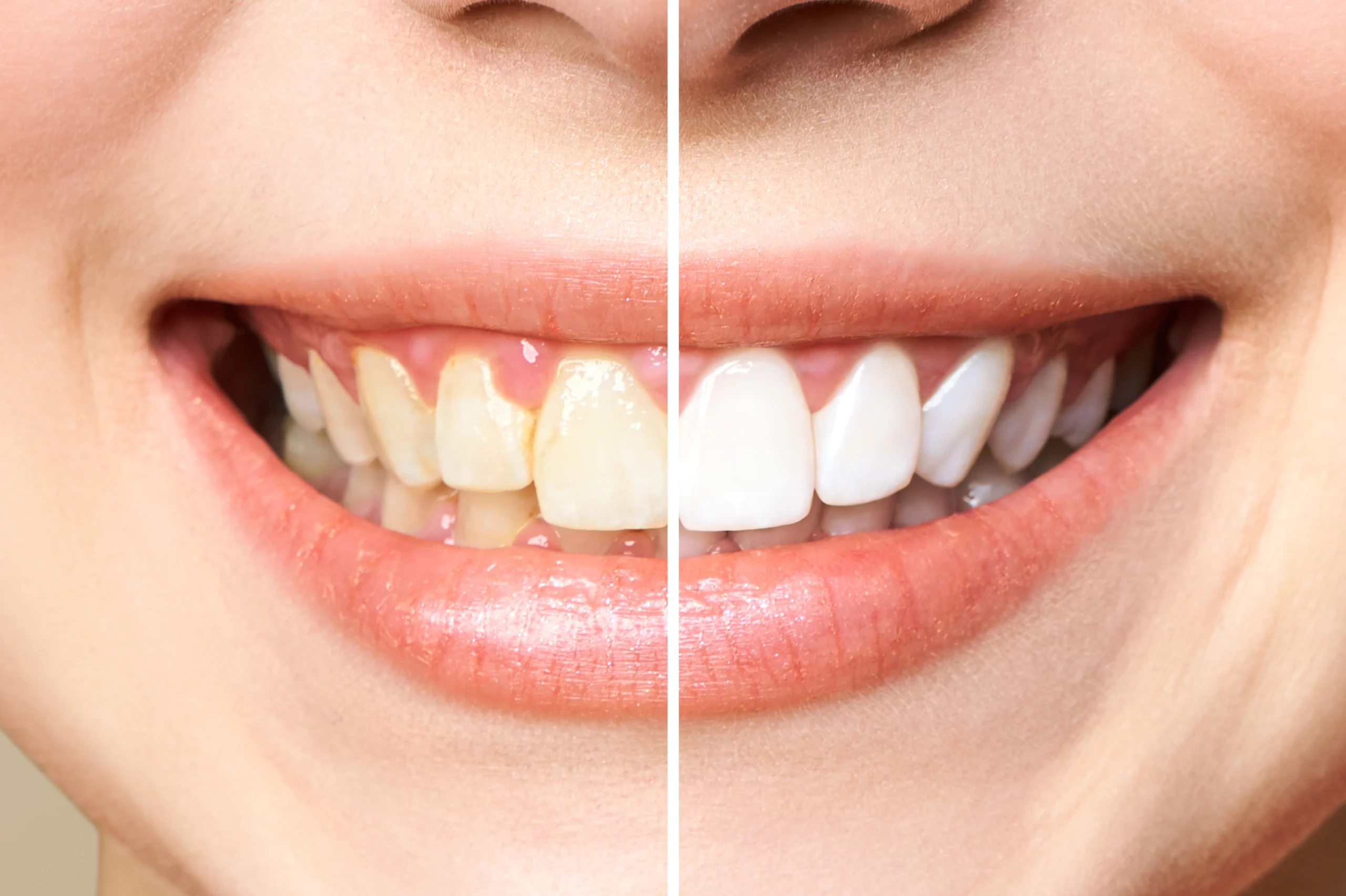
Extrinsic stains sit on the outer surface of the enamel. These are the ones built up by Ccoffee, tea, cola, red sauces, smoking, and shisha. They’re what most people see when they look in the mirror and think “my teeth used to be whiter than this”. Surface stains respond reasonably well to mechanical polishing, including, to a point, baking soda for teeth — because the stain is essentially sitting on top of the tooth.
Intrinsic stains are deeper, embedded inside the enamel and dentin. These come from aging, certain medications (tetracycline is the classic example), trauma, fluorosis from very high fluoride exposure, or genetics. No amount of brushing alone will significantly improve them. They typically require peroxide-based whitening agents or other cosmetic treatments that penetrate the tooth structure. That’s the kind of treatment a clinic provides.
Knowing which type you have determines whether teeth whitening at home is going to do anything for you at all. Most people have a mix of both, which is why home methods often produce a partial result that plateaus and then disappoints.
How to whiten teeth naturally — and what’s actually in the research
There is genuine research on several so-called natural methods. Some of it supports very modest claims. Most of it does not support the dramatic before-and-after promises floating around social media.
Baking soda on its own
Sodium bicarbonate, baking soda, is the most studied of the home options, and the verdict is genuinely mixed in a useful way.
A 2017 review in the Journal of the American Dental Association concluded that baking soda toothpaste has low abrasivity relative to enamel, which makes it reasonably safe for daily use even when patients brush vigorously (1). Plain baking soda scores around 7 on the Relative Dentin Abrasivity (RDA) scale when formulated appropriately, while most commercial whitening pastes sit between 45 and 90 (2). So it’s gentler than a lot of whitening toothpastes people already buy. It works as a mild abrasive that buffs surface stains off the enamel, and it raises mouth pH, which can reduce the conditions that build new stains in the first place.
But, and this is the part the viral videos skip: baking soda for teeth only addresses extrinsic staining. Once you’ve cleared the surface, it can’t go further. That’s why people see a slight improvement in the first few weeks and then nothing.
Is baking soda bad for your teeth?
When used occasionally and gently, baking soda is generally considered safe for most people.Brushing occasionally with baking soda is fine. The risks come from how it’s used, not the substance itself. Brushing aggressively with raw baking soda paste, doing it every day, or combining it with other abrasives (whitening pastes, charcoal powders) can wear down enamel particularly if combined with hard-bristled brushes or excessive brushing force over time, even though baking soda itself ranks low on the abrasivity scale.
The other concern is what baking soda doesn’t provide: fluoride. Toothpastes that carry the ADA Seal of Acceptance contain fluoride because it protects against decay and helps remineralize enamel (3). Brushing only with baking soda strips that protection out of your daily routine. Baking soda for teeth side effects are usually mild for occasional use, but full replacement of normal toothpaste is a bad trade.
Is baking soda bad for your teeth?
Used sensibly, no — for most people, brushing occasionally with baking soda is fine. The risks come from how it’s used, not the substance itself. Brushing aggressively with raw baking soda paste, doing it every day, or combining it with other abrasives (whitening pastes, charcoal powders) can wear down enamel over time, even though baking soda itself ranks low on the abrasivity scale.
The other concern is what baking soda doesn’t provide: fluoride. Toothpastes that carry the ADA Seal of Acceptance contain fluoride because it protects against decay and helps remineralize enamel (3). Brushing only with baking soda strips that protection out of your daily routine. Baking soda for teeth side effects are usually mild for occasional use, but full replacement of normal toothpaste is a bad trade.
How to use baking soda for teeth, if you’re going to
If you want to use it, the reasonable version looks like this: once or twice a week, mix half a teaspoon with enough water to make a paste, apply with a soft brush for no more than two minutes, rinse thoroughly, then brush again with normal fluoride toothpaste. That’s it. The fancier recipes online — pastes with hydrogen peroxide, with charcoal, with three other ingredients — add risk without adding any proven benefit.
Baking soda and lemon for teeth: why this combination is a problem
This one needs its own section, because baking soda and lemon for teeth is everywhere on Saudi and Arab beauty TikTok, and it’s the home remedy most likely to cause permanent damage.
Lemon juice has a pH between 2.0 and 3.0 (4). For context, enamel begins to dissolve — a process called demineralization — at a pH of around 5.5. That means Lemon juice is substantially more acidic than the threshold at which enamel begins to demineralize than the point at which your teeth start to lose minerals.
In one lab study comparing the erosive effect of common drinks on tooth enamel and dentin, lemon juice caused more enamel loss than Coca-Cola, orange juice, apple juice, or Sprite — significantly more than anything else tested (5). A documented case report describes a patient who developed severe enamel erosion and dentin exposure after drinking lemon water daily for around a year (6). There’s a separate case study of a wellness-trend patient who needed restorative work after months of hot lemon water mornings (7).
The thinking behind mixing the two (that the baking soda will “neutralize” the lemon) sounds plausible and is wrong in practice. By the time the mixture touches your teeth,the mixture may still remain acidic enough to soften enamel, the acid has already had access to the enamel, and you’re now scrubbing softened, vulnerable enamel with an abrasive. The combination accelerates erosion rather than preventing it.
Lost enamel cannot biologically regenerate once significant erosion occurs. Once it’s gone, the only fix is restorative: bonding, veneers, or crowns. If you’ve already been doing this for a while, getting an enamel check should come before any whitening conversation. Tam Dental’s brown stains and enamel assessment service handles exactly this kind of evaluation.
Professional teeth whitening vs home remedies: an honest comparison
A fair comparison between professional teeth whitening vs home remedies doesn’t have to be one-sided. Each has a place. The question is whether the place matches what you’re actually trying to achieve.
The main differences come down to four things: how white your teeth get, how long it takes, how safe the process is, and what kind of stain it can move.
| Factor | Home methods | Take-home whitening kit | In-office (professional) whitening |
|---|---|---|---|
| Shade improvement | 0–2 shades, mostly surface stains | 4–6 shades over 2–3 weeks | Several shades of improvement in one session |
| Time to result | Weeks of repeated use | 2–3 weeks of daily wear | 60–90 minutes |
| Works on intrinsic stains? | No | Partially | Yes |
| Gum and enamel protection | Patient-dependent (often poor) | Custom trays reduce gel contact with gums | Gum barrier applied by dentist |
| Sensitivity control | None | Desensitising gel optional | Managed during the session |
| Long-term cost | Cheap per use, results don’t last | Mid-range, lasts months | Higher upfront, often lasts approximately 12–18 months depending on diet, smoking habits, and oral hygiene |
What this table doesn’t capture is the diagnostic part. A clinician looks at your teeth before treatment and tells you whether whitening will even work for your case — because for some people, the cause of the discoloration means whitening won’t fix it. Internal staining from medication, dead nerves in a previously injured tooth, or visible cracks all change the recommendation entirely. A home kit doesn’t tell you any of this; it just gives you a uniform-strength gel and hopes for the best.
The Saudi Ministry of Health’s oral health guidance makes the same general point — that proper assessment and professional dental care are the foundation of safe cosmetic treatment, and that home shortcuts carry risks that often only become visible later (8).
What professional teeth whitening in Jeddah actually looks like
In-office whitening at a clinic isn’t a single product. It’s a process.. At Tam Dental, a typical chair-side whitening appointment runs about 60 to 90 minutes and follows a predictable sequence.
A clinician first cleans the teeth and assesses gum health, since active gum inflammation has to be treated before any whitening goes ahead. Photos are taken to record the starting shade. A protective barrier, usually a flowable resin, is painted over the gum line so the bleaching gel only touches the enamel. A high-concentration hydrogen peroxide gel is then applied to the front of the teeth and activated with a high-intensity LED light.The whitening effect comes primarily from the peroxide gel, while the light may help accelerate the reaction; it’s accelerating the chemical reaction in the gel.
Worth noting: a lot of Jeddah clinics market this as “laser whitening.” It’s almost always actually LED or halogen light. True dental laser-assisted whitening systems are relatively uncommon in routine cosmetic practice. The result depends on the strength of the gel and the technique, not on the word “laser.”
After two to three short application cycles, the gel is rinsed off, the shade is rechecked, and the patient leaves with a noticeably brighter set of teeth and usually a take-home tray with milder gel to extend the result.
For patients who want a more gradual approach, take-home trays are an option on their own — custom-made trays loaded with a lower-strength gel, worn for an hour or two daily over two to three weeks. Take-home kits work well for people who can commit to the routine and want subtler shade changes.
The full process, including pricing and current offers, is set out on Tam Dental’s teeth whitening page, and the broader cosmetic dentistry options — bonding, veneers, smile makeovers — are useful to look at if discoloration is part of a bigger aesthetic concern.
Whitening doesn’t fix everything — when veneers or other treatment makes more sense
Whitening only changes shade. It doesn’t change shape, alignment, gaps, or worn edges. It also doesn’t work on existing dental restorations. Crowns, veneers, composite bondings, and tooth-coloured fillings stay the colour they were made, which means whitening your natural teeth around them can leave a visible mismatch.
For deep intrinsic stains that don’t respond to bleaching, or for cases that involve more than just colour, dental veneers at Tam Dental cover the visible surface entirely and let the cosmetic team design a result that addresses shade and shape together. For patients thinking about a full smile transformation rather than a shade improvement, the Hollywood Smile service is the planning track that covers veneers, whitening, and minor alignment as a coordinated treatment.
A good consultation is the part that sorts out which of these you actually need. Most patients who come in convinced they want veneers actually need whitening plus a small amount of cosmetic refinement, and most patients who come in for whitening turn out to have one or two specific concerns that whitening alone won’t solve. The clinical assessment is where that conversation happens.
Aftercare: keeping the result in Jeddah’s climate
Whatever method you use, the result lasts longer if your daily habits cooperate. In a Jeddah context that mostly means three things: pace your qahwa and tea, rinse with water afterward, and don’t let the dry climate push you toward constantly sipping sweet, acidic drinks throughout the day. Sipping is worse than drinking — the enamel never gets a break to remineralize between exposures.
Brushing twice a day with a fluoride toothpaste, flossing, and a hygiene visit every six months is the standard guidance the ADA and most major dental bodies give, and the Ministry of Health in Saudi Arabia echoes the same approach in its public oral health resources (8). For patients who’ve had in-office whitening, avoiding deeply pigmented food and drink for the first 48 hours, when the enamel is still slightly more porous, makes a noticeable difference to how long the result holds.
The basics, in other words, do most of the work. The dramatic before-and-after photos people see online are real, but they exist because someone got the proper treatment done and then also took care of their teeth afterward.
A practical decision framework
If you’re trying to work out whether to handle whitening at home or at a clinic, the honest test is this:
For Jeddah residents, Saudi locals and expat families alike, the practical advantage of going to a clinic like Tam Dental’s main dental clinic in Jeddah is the diagnostic part as much as the whitening itself. You get a proper assessment, a treatment plan that fits your actual case, and a result that lasts.
FAQ section
Is teeth whitening safe?
Professional teeth whitening, performed under clinical supervision, is considered one of the safest cosmetic dental procedures available. The most common side effect is short-term sensitivity to cold, which usually resolves within a few days. Home methods carry more risk because they’re unsupervised. The most damaging combinations involve acid (lemon juice, vinegar) or excessive abrasion (charcoal, daily baking soda).
How long does professional teeth whitening last in Jeddah?
With sensible aftercare (brushing twice daily, regular hygiene visits, and moderating qahwa, tea, and shisha exposure), in-office results typically hold for 12 to 18 months. Touch-ups with take-home trays can extend that further.
Will whitening damage my enamel?
Properly performed When performed correctly under professional supervision, modern peroxide-based whitening is considered safe for enamel.The peroxide gel works primarily through oxidation rather than mechanical abrasion. The damage people associate with whitening usually comes from home methods that combine acid and scrubbing, or from over-the-counter products used incorrectly.
Does insurance cover teeth whitening in Saudi Arabia?
Cosmetic teeth whitening is generally not covered by Saudi medical insurance plans, as it’s classified as elective rather than medically necessary. Some expat insurance plans reimburse cleanings and check-ups, which can offset adjacent costs.
Can I whiten teeth with crowns or veneers?
The natural teeth around restorations can be whitened, but the restorations themselves stay the same shade. This can create a colour mismatch. If you have visible crowns or veneers, a consultation should happen before any whitening. Sometimes the right plan is to whiten first and then replace the restorations to match the new shade.
Are over-the-counter whitening strips effective?
OTC strips can produce mild shade improvement over several weeks and are safer than home recipes. They tend to give uneven results because the strip doesn’t conform perfectly to every tooth, and they offer no protection for the gums. For patients who want predictable results, a custom take-home kit from a clinic gives substantially better outcomes for a moderate price difference.
Sources
- Lippert F. Effect of Baking Soda in Dentifrices on Plaque Removal. The Journal of the American Dental Association. 2017;148(11S):S4–S9. Available at: https://jada.ada.org/article/S0002-8177(17)30822-X/fulltext
- Hara AT, Turssi CP. Baking Soda as an Abrasive in Toothpastes: Mechanism of Action and Safety and Effectiveness Considerations. The Journal of the American Dental Association. 2017;148(11S):S27–S33.
- American Dental Association. ADA Seal of Acceptance — Product Categories: Toothpaste. Available at: https://www.ada.org/resources/ada-library/ada-seal-of-acceptance
- Biology Insights. Is Eating Lemon Bad for Your Teeth? (2026 review citing measured pH of lemon juice). Available at: https://biologyinsights.com/is-eating-lemon-bad-for-your-teeth/
- Ehlen LA, Marshall TA, Qian F, Wefel JS, Warren JJ. Acidic beverages increase the risk of in vitro tooth erosion. Available via PubMed: https://www.ncbi.nlm.nih.gov/pmc/articles/PMC4452714/
- Mosaico G, Casu C. Particular dental erosion (case report of dental erosion caused by daily lemon juice intake). Pan African Medical Journal. 2018;30:190. Available at: https://www.ncbi.nlm.nih.gov/pmc/articles/PMC6235510/
- Dental Health Concepts. The Dark Side of Lemon Water: A Case Study. Clinical case discussion of enamel erosion from daily lemon water. Available at: https://www.dhconcepts.com/the-dark-side-of-lemon-water/
- Ministry of Health, Kingdom of Saudi Arabia. Oral Health Awareness Platform. Available at: https://www.moh.gov.sa/en/awarenessplateform/oralhealth/pages/default.aspx
- World Health Organization. Oral Health Country Profile — Saudi Arabia, 2022. Available at: https://cdn.who.int/media/docs/default-source/country-profiles/oral-health/oral-health-sau-2022-country-profile.pdf