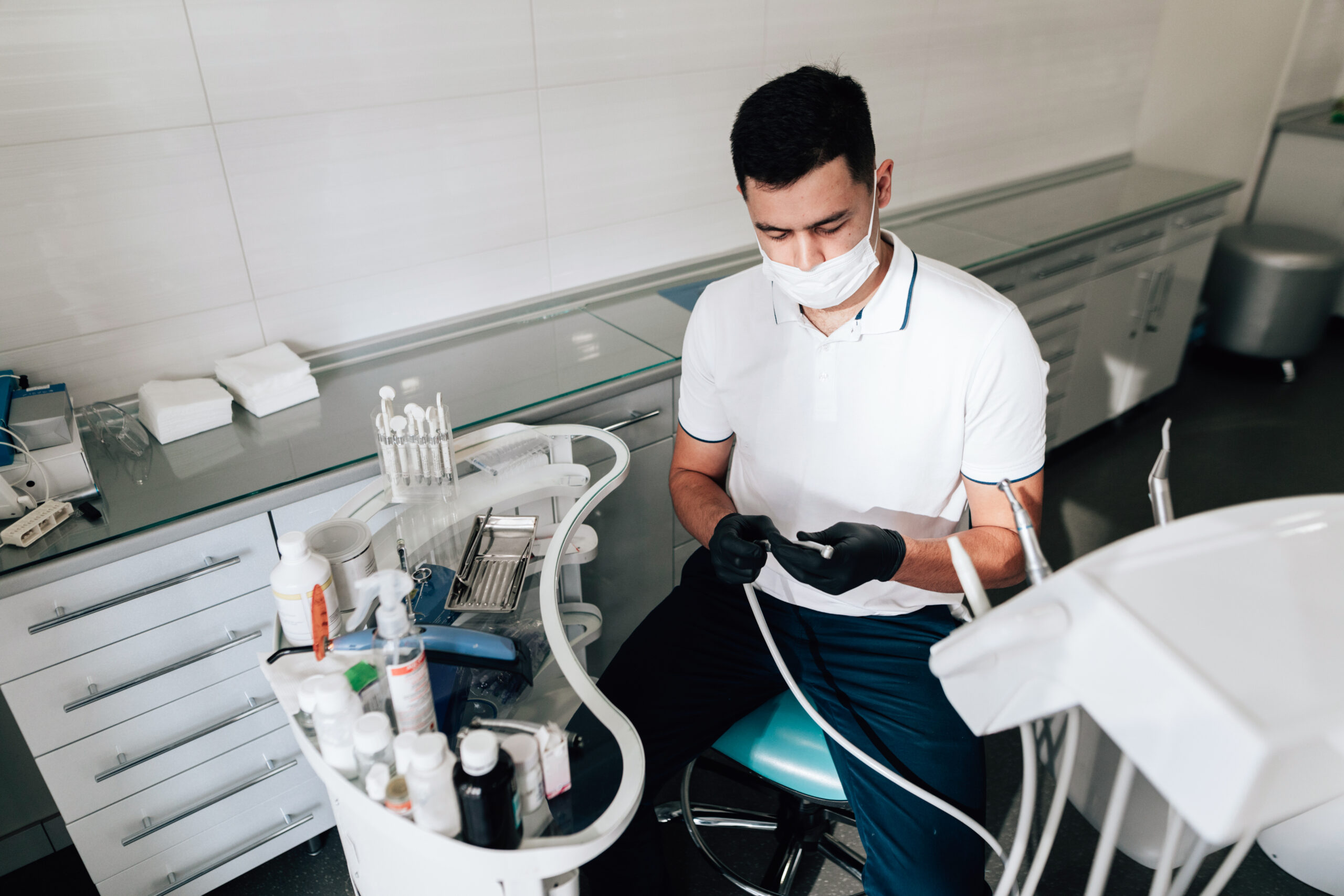
A dental specialist is a dentist who has completed extra accredited training, usually two or more years beyond dental school, in one focused area of dentistry such as gums, root canals, braces, or jaw surgery.¹ Your general dentist handles your routine care and check-ups; a specialist steps in when a problem needs deeper expertise or more complex treatment.
We treat patients across all of these areas every day at our clinic in Jeddah, and “you need to see a specialist” is a sentence that worries a lot of people more than it should. So here is what it actually means — explained the way we explain it across the chair to our own patients: the main types of specialist, when one is the right call instead of a general dentist, whether you need a referral, and what to look for when you choose one.
What is a dental specialist?
Every specialist starts as a dentist. After earning a dental degree, they apply to a recognized postgraduate program and train for two or more additional years in a single discipline before they can call themselves a specialist.¹ That training is hands-on and narrow on purpose: an orthodontist spends those years moving teeth and correcting bites, an endodontist spends them inside the root canal system, and so on.
The result is a clinician who sees one type of case all day, every day. For a complicated tooth, a difficult extraction, or a full-mouth rehabilitation, that depth of focused experience is what makes the difference.
To protect patients, dental specialties are formally recognized only where the knowledge and skills go well beyond what a general dental program teaches. In the United States, the body that recognizes them is the National Commission on Recognition of Dental Specialties and Certifying Boards, and it currently recognizes twelve dental specialties.²
The main types of dental specialists
Most patients only ever meet a handful of these. Here are the specialists you are most likely to be referred to, with the kind of problem each one solves.
Orthodontist — corrects the position of teeth and jaws. If you have crowding, gaps, an overbite, an underbite, or you want clear aligners, this is the specialist who plans and manages that movement. Orthodontics and dentofacial orthopedics is the recognized specialty covering malocclusion and jaw alignment.²
Endodontist — the root canal specialist. Endodontists deal with the soft tissue (pulp) inside the tooth and the tissues around the root. When a tooth is badly decayed, infected, or painful and you want to save it rather than remove it, an endodontist is often the person who can.²
Periodontist — the gum and dental implant specialist. Periodontists prevent, diagnose, and treat diseases of the gums and the bone that supports your teeth, and they place dental implants. Bleeding gums that do not settle, loose teeth, or gum recession are typical reasons to see one.²
Oral and maxillofacial surgeon — handles surgery of the mouth, jaw, and face: complicated or impacted wisdom teeth, jaw problems, facial trauma, and surgical implant cases.² These are the procedures that go beyond what a general dentist or general clinic chair can manage.
Prosthodontist — the reconstruction specialist. Prosthodontists rebuild and replace teeth with crowns, bridges, veneers, dentures, and implant-supported restorations, and they plan full-mouth rehabilitation.²
Pediatric dentist — focuses entirely on children, from infancy through the teenage years, including children with special health care needs.² They are trained to make a child’s visit calm and to manage the specific issues of growing teeth.
The full list of twelve recognized specialties also includes oral and maxillofacial pathology, oral and maxillofacial radiology, oral medicine, orofacial pain, dental public health, and dental anesthesiology — fields most patients will never need to visit directly, but which support diagnosis and care behind the scenes.²
In our own clinic, these areas map to dedicated departments: orthodontics, including clear aligners, root canal (endodontic) treatment, dental implants and periodontal care, oral and maxillofacial surgery, dental prosthetics and restorations, and pediatric dentistry.
What is the difference between a general dentist and a specialist?
A general dentist is your primary dental care provider. They examine your mouth, clean your teeth, fill cavities, place many crowns, treat straightforward root canals, and — importantly — they are the one who spots when something needs a specialist and refers you on.³
A specialist has trained for years in a single area and takes the cases that sit outside routine care: the molar with curved, hard-to-reach canals, the gum disease that keeps coming back, the bite that needs orthodontic correction, the jaw surgery. Think of the general dentist as the doctor who knows your whole mouth and the specialist as the expert called in for one specific problem. Both matter, and good care usually involves them working together.
When should you see a dental specialist instead of a general dentist?
Start with your general dentist for almost everything: check-ups, cleanings, fillings, and the first look at any new pain or concern. They will tell you if a specialist is needed.
You are likely to be referred to, or to benefit from, a specialist when:
- A tooth needs a root canal that is complex, or a previous root canal has failed (endodontist).
- You have gum disease that is not improving, loose teeth, or you are planning dental implants (periodontist).
- You want to straighten your teeth or correct your bite with braces or aligners (orthodontist).
- You need surgical removal of wisdom teeth, jaw surgery, or treatment after facial injury (oral and maxillofacial surgeon).
- You are missing several teeth and need crowns, bridges, dentures, or a full-mouth restoration (prosthodontist).
- Your child needs care from someone trained specifically for children (pediatric dentist).
See a dentist promptly — general or specialist — if you have ongoing pain, swelling, bleeding that does not stop, or a tooth that has been knocked loose or out. This article is general information and is not a substitute for an examination; a proper diagnosis can only come from seeing a dentist in person.
Do I need a referral to see a dental specialist?
In many countries a referral from your general dentist or a primary care physician is the usual route to a specialist, and may be required by your insurance.³ In private practice in Saudi Arabia, you can also book directly with a clinic that has specialists on staff — you do not always need a formal referral to be seen.
Either way, it helps to start with an assessment so the right specialist handles your case from the beginning. If you are unsure which type of dentist you need, a consultation is the simplest way to find out: the clinic examines the problem and directs you to the correct specialist, rather than you having to guess.
Why choose a clinic with multiple dental specialists under one roof?
Many dental problems do not stay in one lane. An implant case can involve a periodontist or surgeon to place the implant and a prosthodontist to build the crown on top. A full smile makeover can touch orthodontics, gum treatment, and restorative work. When all of those specialists work in the same clinic, sharing the same records and imaging, we can plan your treatment as one coordinated case instead of sending you between different offices that never speak to each other.
That coordination is the practical advantage of being treated where the specialists already work together — and for an expat family in Jeddah it means the general dentistry you visit for a check-up and the specialist you may need next belong to the same team, with multilingual staff who can explain each step in a language you are comfortable with.
Who we are — about Tam Dental
In case you are reading this without knowing us: Tam Dental is an institutional dental clinic in Jeddah, built so that a patient can find a general dentist and every major specialty under one roof. Our consultants cover orthodontics, endodontics, periodontics and implants, oral and maxillofacial surgery, prosthodontics, and pediatric dentistry, and many of them are trained and board-certified at leading universities abroad — including Harvard, Boston University, NYU, the University of Toronto, King’s College London, and the Royal College of Surgeons of Edinburgh. As a team we bring more than fifteen years of experience and have cared for over 5,000 patients, with 1,800+ dental implants and 1,000+ clear-aligner cases completed. What we care about most is the part you do not always see on a website: explaining your options honestly so you can make your own decision, and treating your mouth as one connected system rather than a list of separate procedures.
If you are not sure which specialist your situation calls for, the simplest first step is to book an online consultation with us — currently offered with a discount — where one of our team reviews your case and points you to the right department. You are also welcome to call the clinic or visit us in person.
What is a dental specialist?
A dental specialist is a dentist who has completed two or more years of accredited training beyond dental school in one focused area, such as orthodontics, endodontics, periodontics, oral surgery, prosthodontics, or pediatric dentistry.¹ They handle cases that need more depth than routine general dental care.
What are the main types of dental specialists?
The ones patients see most often are the orthodontist (braces and aligners), endodontist (root canals), periodontist (gums and implants), oral and maxillofacial surgeon (jaw and surgical cases), prosthodontist (crowns, bridges, dentures, full-mouth restoration), and pediatric dentist (children). In total there are twelve formally recognized dental specialties.²
When should I see a dental specialist instead of a general dentist?
See your general dentist first for check-ups, cleanings, fillings, and any new concern. You move to a specialist when a problem is more complex — a difficult or failed root canal, persistent gum disease, implants, orthodontics, surgical extractions, or major reconstruction — usually on your dentist’s recommendation.
Do I need a referral to see a dental specialist?
Often a referral from your general dentist is the usual path, and some insurers require one.³ In private practice in Saudi Arabia you can also book directly with a clinic that has specialists on staff. A short consultation will confirm which specialist you actually need.
What is the difference between a general dentist and a specialist?
A general dentist is your primary provider for everyday care and is the one who refers you onward; a specialist has years of focused training in a single area and takes the more complex cases. Good care usually involves both working together.
Why choose a clinic with multiple dental specialists?
Because many treatments cross more than one specialty. When the specialists share one clinic, records, and treatment plan, your care is coordinated rather than scattered across separate offices — which is faster, clearer, and easier to follow.
Sources
- American Dental Association (CareerCenter) — How to become an Orthodontist (two or more years of accredited specialty training after dental school): https://careercenter.ada.org/article/how-to-become-an-orthodontist
- National Commission on Recognition of Dental Specialties and Certifying Boards (ADA) — Recognized Dental Specialties (the 12 recognized specialties and their definitions): https://ncrdscb.ada.org/recognized-dental-specialties
- Cigna Healthcare — Types of Dental Specialists (general dentists refer to specialists; how to know which type you need): https://www.cigna.com/knowledge-center/common-types-of-dentists