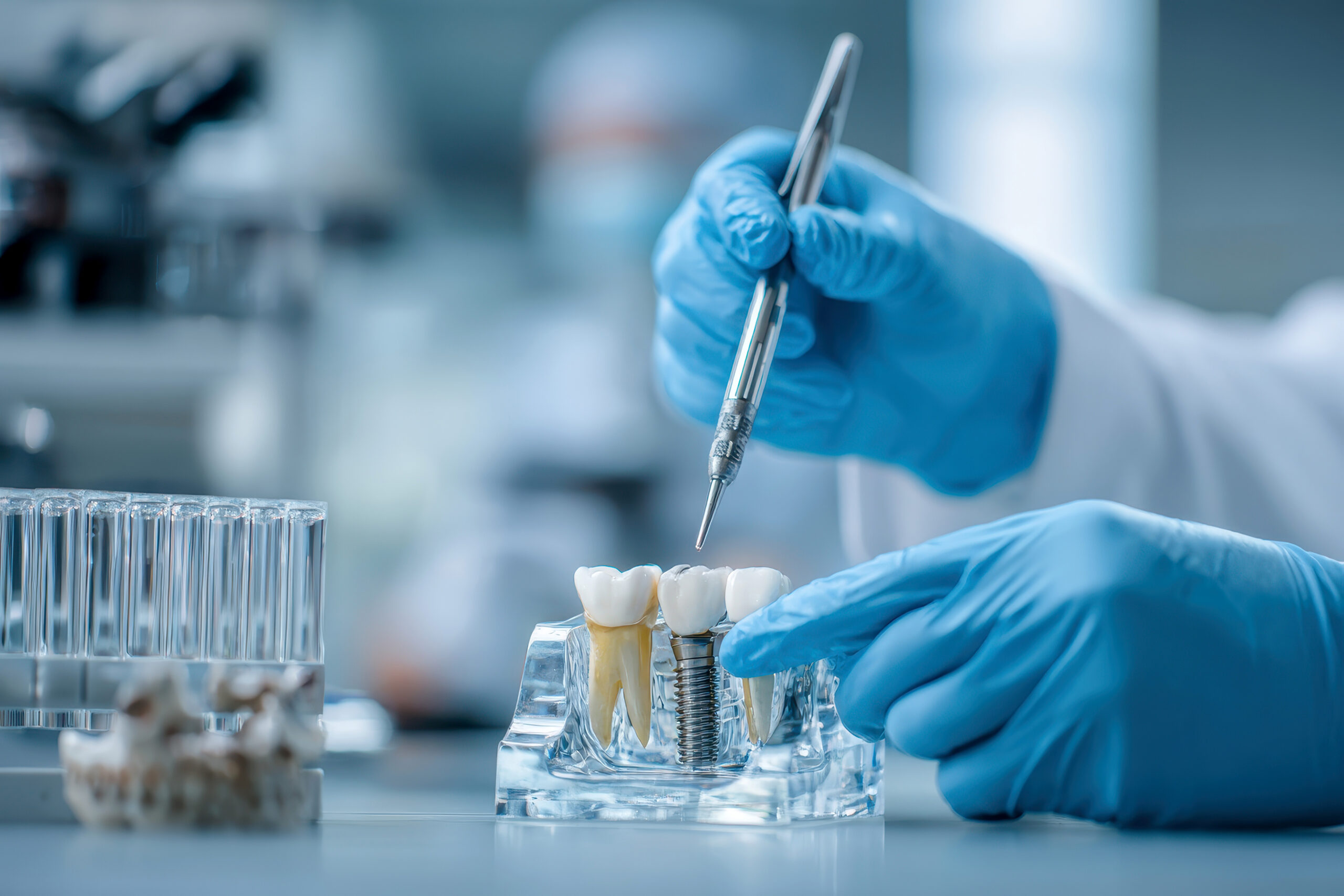
Full mouth dental implants can replace all or most missing teeth with a complete set of artificial teeth supported by implants placed in the jawbone.
Unlike a removable conventional denture that rests on the gums, an implant-supported restoration connects to stable implant foundations. This can provide better stability while speaking and eating, improve comfort and help preserve the jawbone.
Full mouth treatment does not usually mean placing one implant for every missing tooth. A carefully planned number of implants can support a complete bridge or denture across the upper jaw, lower jaw or both.
The exact treatment design depends on your remaining teeth, gum health, bone condition, bite and general health.
What Are Full Mouth Dental Implants?
A dental implant is an artificial tooth root, usually made from titanium or another biocompatible material, that is surgically placed in the jawbone.
For a full mouth restoration, several implants are positioned across the jaw to support a full set of replacement teeth. The complete restoration has three main parts:
- Dental implants placed inside the jawbone
- Abutments that connect the implants to the replacement teeth
- A full bridge or implant-supported denture that restores the visible teeth
The implants integrate with the surrounding bone through a process known as osseointegration. Once stable, they provide a foundation for the final prosthetic teeth. [1]
Full Mouth Versus Full-Arch Dental Implants
The terms “full mouth” and “full arch” are sometimes used interchangeably, but they do not always mean exactly the same thing.
A dental arch refers to all the teeth in one jaw. A full-arch restoration replaces either:
- All the upper teeth
- All the lower teeth
A full mouth restoration normally involves both the upper and lower arches.
Some clinics use “full mouth dental implants” when discussing one complete arch, so patients should confirm whether a proposed treatment plan covers one jaw or both.
This distinction is important when comparing treatment plans, timelines and what is included in the final restoration.
Who May Need Full Mouth Dental Implants?
Full mouth dental implants may be considered for patients who:
- Have lost all their teeth
- Have only a few teeth remaining
- Have multiple teeth that cannot be predictably restored
- Find conventional dentures unstable or uncomfortable
- Have advanced dental disease affecting most of the mouth
- Want a more stable alternative to removable dentures
- Can commit to long-term cleaning and professional maintenance
The purpose of the assessment is not simply to decide whether implants can be placed. The dental team must first determine whether any natural teeth can and should be preserved.
Removing repairable teeth solely to simplify implant treatment may not be the most conservative option. Every remaining tooth should be assessed individually before recommending full mouth replacement.
Can All Your Teeth Be Replaced With Dental Implants?
Yes. Dental implants can support a complete set of replacement teeth in the upper jaw, lower jaw or both.
However, replacing every tooth does not normally require one implant per tooth. Instead, the dentist positions several implants strategically to support a complete prosthetic arch.
The number and location of implants depend on:
- Jawbone volume and density
- The upper or lower jaw
- Implant position and angulation
- The type of final restoration
- Bite forces
- Remaining teeth
- General and oral health
- Whether bone grafting is required
A treatment plan should be based on clinical examination and three-dimensional imaging, rather than selecting an implant number before assessing the patient.
Full Mouth Implant Treatment Options
There are several ways to restore a complete mouth with dental implants. The correct option depends on the patient’s clinical needs, not simply their preference for a particular treatment name.
Fixed implant-supported teeth
A fixed full-arch bridge is attached to the implants and is not removed by the patient during normal daily use.
This option can provide strong stability and a natural-looking result. However, the patient must be able to clean carefully beneath and around the restoration.
The bridge may still need to be removed professionally for certain maintenance or repairs.
Removable implant-supported overdenture
An implant-supported overdenture connects to implants for improved stability but can be removed by the patient for cleaning.
It is generally more secure than a conventional denture because the implant attachments reduce movement. For some patients, removability also makes daily hygiene easier.
All-on-4 and All-on-6 treatment concepts
All-on-4 and All-on-6 are specific full-arch treatment concepts that use four or six implants to support replacement teeth.
Because TAM Dental already has dedicated guides for these treatments, this article will not repeat their full details. Patients can read:
The number of implants should be selected according to bone condition, prosthetic design and the clinical plan—not by assuming that more or fewer implants are automatically better.
Are You a Candidate for Full Mouth Dental Implants?
A suitable candidate generally needs healthy or treatable gums, sufficient jawbone to support implants and good enough general health for oral surgery.
The assessment may consider:
- Active gum disease
- Bone quantity and quality
- Smoking or vaping
- Diabetes control
- Medications
- Previous dental treatment
- Teeth grinding
- Oral hygiene
- Ability to attend follow-up appointments
- Expectations for the final teeth
Inadequate bone does not always rule out implant treatment. Depending on the location and severity of bone loss, the dentist may consider bone grafting, sinus augmentation or a different implant configuration.
The American Academy of Periodontology identifies general health, oral health, adequate jawbone and healthy gum tissues as important factors when assessing implant candidates. [2]
How Is Full Mouth Implant Treatment Planned?
Full mouth implant treatment involves both surgical and restorative planning.
The surgical plan determines where the implants can be placed safely. The restorative plan determines the position, appearance and function of the final teeth.
A comprehensive assessment may include:
- Medical and dental history
- Examination of the teeth and gums
- Assessment of any remaining teeth
- CBCT or three-dimensional imaging
- Digital scans or impressions
- Bite analysis
- Facial and smile evaluation
- Discussion of fixed and removable options
- Planning for temporary teeth
- A written sequence of treatment
Complex cases may involve a periodontist or oral surgeon for implant placement and a prosthodontist for the design of the final teeth. Mayo Clinic notes that implant planning can involve several dental and medical specialties depending on the patient’s condition. [3]
What Happens During Treatment?
The exact sequence varies, but a full mouth implant plan commonly includes several stages.
1. Assessment and digital planning
The team examines your teeth, gums, jawbone and bite. Imaging helps determine implant positions and whether preparatory treatment is required.
2. Treating active dental disease
Gum infection, decay or other active problems should be addressed before or as part of the implant plan.
Teeth that cannot be preserved may need to be removed. Teeth with a reasonable long-term prognosis should not automatically be extracted.
3. Implant placement
The implants are surgically placed in planned positions within the jawbone. Local anaesthesia is commonly used, with other comfort options considered according to the case.
4. Temporary teeth
Some patients may receive temporary teeth on or soon after implant placement. Others may need a different temporary restoration while the implants heal.
“Same-day teeth” does not mean that the entire healing process is complete. The first teeth may be provisional and later replaced with the final restoration.
5. Osseointegration
The implants need time to integrate with the jawbone. The American Academy of Periodontology notes that this stage may take approximately two to six months, depending on the patient and treatment. [1]
6. Final prosthetic teeth
After the implants are sufficiently stable, the final bridge or implant-supported denture is designed and fitted.
The dentist checks the fit, bite, appearance, speech and ability to clean around the restoration.
Benefits of Full Mouth Dental Implants
Full mouth dental implants can provide several advantages compared with conventional removable dentures.
Improved stability
Because the replacement teeth are supported by implants, they are less likely to move while speaking or eating.
Better chewing function
A stable restoration can make it easier to eat a wider variety of foods, although patients should continue following their dentist’s guidance.
Support for the jawbone
Dental implants replace part of the function of tooth roots and integrate with the jawbone. This can help preserve bone compared with leaving the jaw without teeth. [1]
Natural appearance
The final teeth can be designed around the patient’s face, smile, lip support and preferred tooth shape and colour.
Greater confidence
Stable replacement teeth may help patients feel more comfortable when speaking, eating and smiling.
These benefits depend on appropriate treatment planning, successful healing and continued maintenance.
What Are the Risks and Limitations?
Full mouth dental implants involve surgery and are not risk-free.
Possible risks include:
- Infection around an implant
- Failure of an implant to integrate with the bone
- Nerve injury
- Sinus complications in the upper jaw
- Gum or bone loss around implants
- Loosening or fracture of prosthetic components
- Chipping or wear of the replacement teeth
- Difficulty cleaning beneath the restoration
Smoking can interfere with healing and contribute to implant complications. Poor plaque control can also cause inflammation and peri-implant disease.
Mayo Clinic advises contacting the treating surgeon if swelling, soreness or other problems worsen after implant surgery. [3]
How Do You Care for Full Mouth Dental Implants?
Implants cannot develop cavities, but the gum and bone around them can become inflamed or infected.
Daily care may include:
- Brushing as directed
- Cleaning beneath the bridge
- Using interdental brushes or specialist floss
- Using an oral irrigator when recommended
- Avoiding tobacco
- Managing teeth grinding
- Attending regular examinations
- Receiving professional implant maintenance
The replacement teeth and prosthetic components can also wear or become damaged over time. Long-term follow-up is therefore part of the treatment—not an optional extra.
The American Academy of Periodontology recommends consistent home care and regular dental visits to maintain implants and monitor the surrounding gums and bone. [2]
Full Mouth Dental Implants in Jeddah
TAM Dental provides full mouth implant assessment and treatment planning for patients in Jeddah and across Saudi Arabia.
Full mouth cases can require collaboration between implant, periodontal, oral surgery and prosthodontic specialists. TAM Dental’s multidisciplinary team can assess the surgical foundation and design of the final teeth as one coordinated treatment plan.
The clinic uses three-dimensional imaging and digital planning to assess bone, implant positions, bite and prosthetic requirements before treatment begins.
Patients can review TAM Dental’s implant service or book an assessment to understand which teeth can be preserved and which full mouth restoration options may be appropriate.
For detailed pricing information, read the separate guide to dental implant costs.
Frequently Asked Questions
What are full mouth dental implants?
Full mouth dental implants use several implants placed in the jawbone to support a complete set of replacement teeth in the upper jaw, lower jaw or both.
Does full mouth treatment require one implant for every tooth?
No. A complete bridge or implant-supported denture can usually be supported by a smaller number of strategically positioned implants. The correct number depends on the individual treatment plan.
Can full mouth dental implants replace both upper and lower teeth?
Yes. Treatment can replace one full arch or both arches. Patients should check whether a proposed plan refers to one jaw or the entire mouth.
Are full mouth dental implants fixed?
They can be fixed or removable. A fixed bridge remains attached during everyday use, while an implant-supported overdenture can be removed by the patient for cleaning.
Do all remaining teeth need to be removed?
Not necessarily. Each tooth should be assessed individually. Teeth with a reasonable long-term prognosis may be preserved, while teeth that cannot be predictably restored may need removal.
Can I have temporary teeth during treatment?
Many patients can receive temporary teeth while their implants heal, but the type and timing depend on implant stability, bone condition and the treatment plan.
How long do full mouth dental implants last?
Implants are designed as a long-term treatment, but no dentist can guarantee that they will last for life. Longevity depends on healing, oral hygiene, smoking, bite forces, maintenance and regular follow-up.
Who plans full mouth implant treatment?
Treatment commonly involves an implant surgeon, periodontist or oral surgeon together with a restorative dentist or prosthodontist who designs the replacement teeth.