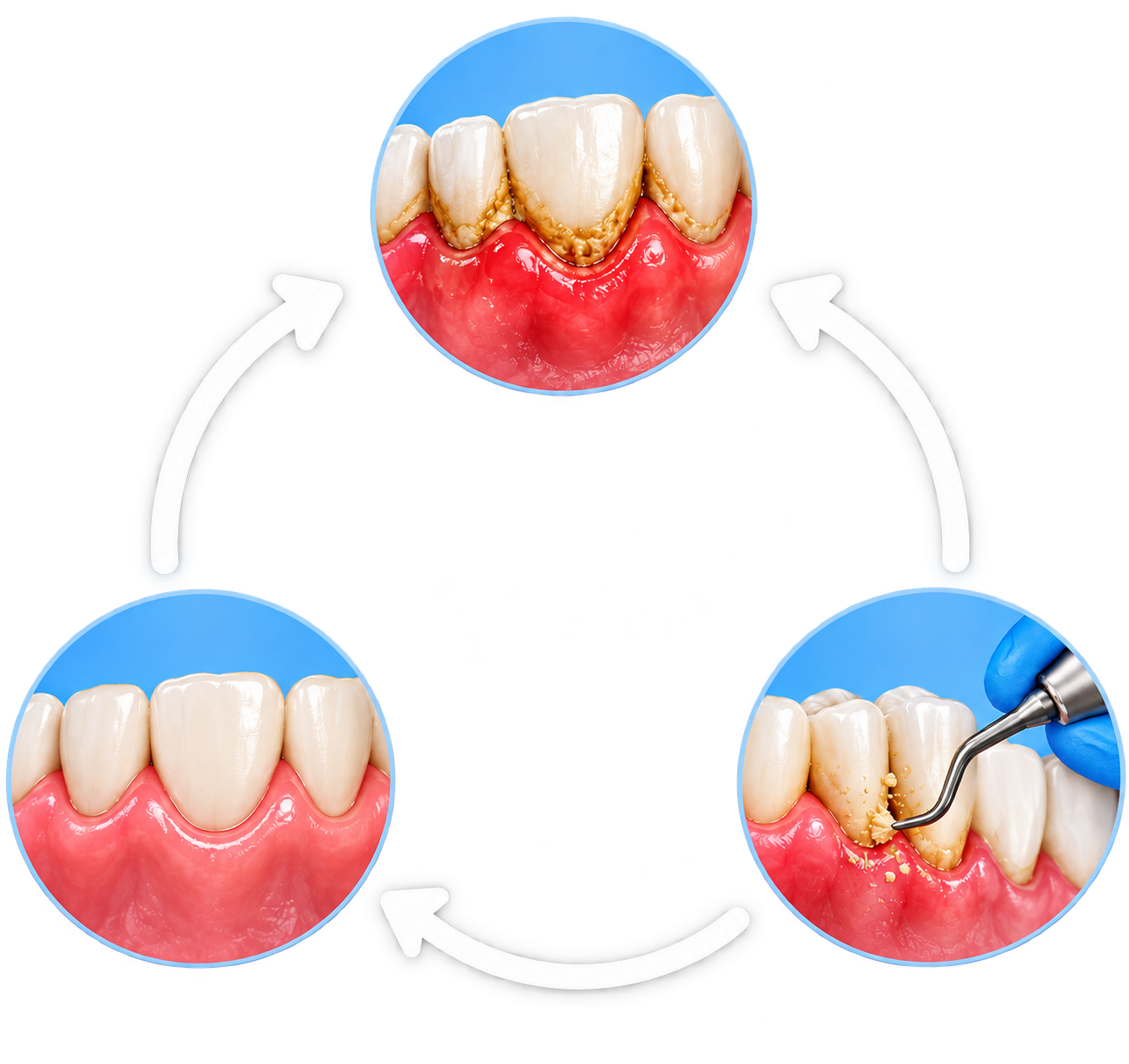
Benefits
Gum treatment helps control bleeding and swelling caused by plaque and tartar buildup.
Early treatment helps reduce gum recession and the formation of periodontal pockets around the teeth.
Treating gum disease helps protect the bone and tissues that hold teeth in place.
Treating gum disease reduces the risk of tooth loosening and loss in advanced cases.
Types of gum disease
It is an inflammation that affects the gums, causing them to become red, swollen, and bleed while brushing teeth. It can often be treated with professional cleaning and proper daily care.
An advanced stage of gum disease affects the tissues and bone supporting the teeth, and may cause gum recession and the formation of periodontal pockets, requiring specialized treatment and continuous monitoring.
Gum treatments that are right for you
At Tam Dental Clinic, we offer a range of gum treatments starting with professional cleaning and deep cleaning, and extending to advanced gum treatment and periodic follow-up. The doctor determines the appropriate treatment for each patient after examining their gums.
Team of Experts
Get to know our team of dental experts at Tam.
Find answers to frequently asked questions about gum diseases.
There is no single treatment that works for all patients. Treatment depends on the type and severity of gum disease and the results of the examination. It may include professional cleaning, deep cleaning, specialized gum treatment, or regular follow-up.
Not always, especially in the early stages. Bleeding, swelling, bad breath, receding gums, or loose teeth may appear with little or no pain.
No. Regular cleaning removes plaque and tartar from tooth surfaces and around the gum line. Deep cleaning, or root planing and scaling, is a non-surgical treatment that removes plaque and tartar from below the gum line and cleans root surfaces.
This cannot be determined from symptoms alone. The dentist needs to examine the gums and surrounding tissues to determine if a deep cleaning is appropriate for your case.
Yes, gingivitis can often be treated with professional cleanings and proper daily dental care.
Lost bone cannot be restored, but the disease can often be controlled with specialized gum treatment and ongoing follow-up.
The cost depends on the condition of the gums and the type of treatment required. Therefore, the dentist needs to examine the condition first to determine the appropriate treatment and give you an accurate estimate.
Yes, it may recur, especially if the risk factors persist or the patient does not adhere to follow-up and daily dental care.
This varies depending on your oral health and risk factors. Your doctor will determine the appropriate examination and follow-up schedule.
If bleeding is persistent or frequent when brushing or flossing, especially if accompanied by swelling, bad breath, receding gums, or loose teeth.