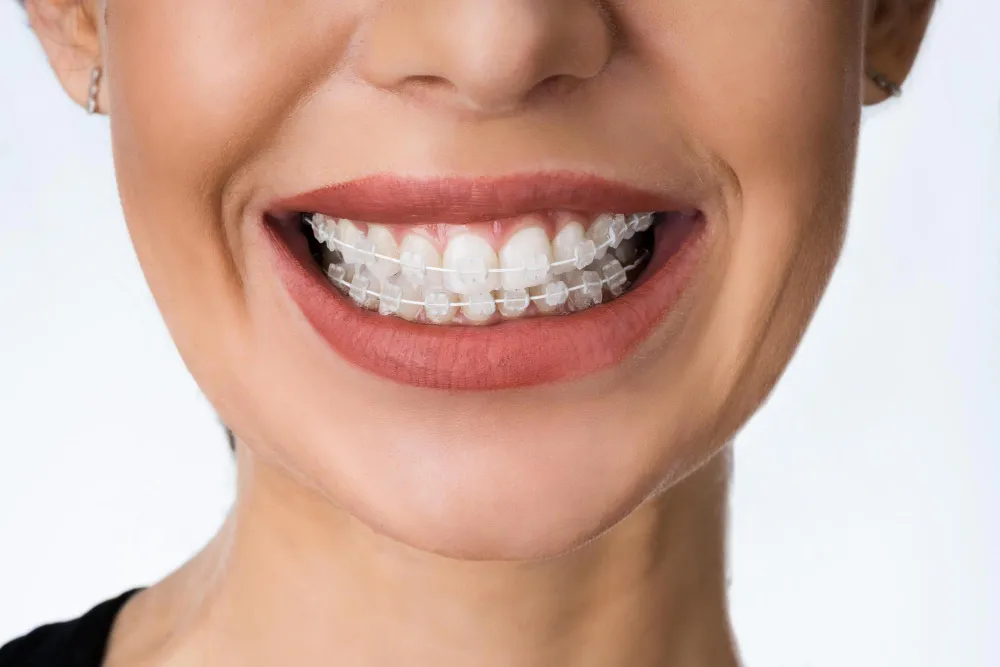
Ceramic braces are fixed braces with clear or tooth-coloured brackets in place of metal ones. They move teeth the same way metal braces do, with brackets and a wire applying gentle, steady pressure, but they are less noticeable when you smile.¹ They suit people who need fixed braces and would prefer them not to show.
They are not right for every case, and they need a little more care. Here is what to weigh up.
What are ceramic dental braces?
Each bracket is made of ceramic or porcelain and is bonded to the front of a tooth. A wire runs through the brackets and guides the teeth into position.¹ ² Some patients also have tooth-coloured wires or clear elastic ties, depending on the plan.¹
Ceramic braces are sometimes called “clear braces”, but they are not clear aligners. Aligners are removable trays. Ceramic braces are fixed and stay on the teeth until treatment ends.¹
Ceramic braces vs metal braces
Both work in the same way and both are effective. The differences are in appearance, durability and, sometimes, cost.¹
| Ceramic braces | Metal braces | |
|---|---|---|
| Appearance | Clear or tooth-coloured brackets that blend with the teeth | Stainless steel brackets and wires, more visible |
| Durability | Effective, but the material can be more brittle and needs extra care | Highly durable |
| Complex cases | Suitable for many cases | Sometimes recommended for certain complex cases |
| Cost | May cost more in some cases because of the materials | Often the more affordable option |
| Comfort | Varies from person to person | Varies from person to person |
So, ceramic braces or metal braces? Neither is automatically better. Metal may be recommended if you need a highly durable appliance or have complex needs. Ceramic is a good option if you want fixed braces that are less noticeable.¹
Ceramic braces vs clear aligners
Aligners are harder to see and can be taken out to eat and clean. Fixed braces, ceramic included, tend to move teeth faster and treat a wider range of problems.² If you know you would struggle to wear aligners for most of the day, fixed ceramic braces remove that worry. We compare the two approaches in Clear Aligners vs Braces.
Who are ceramic braces suitable for?
- Adults and older teenagers who want a discreet fixed option.¹
- People whose case needs fixed braces, where aligners would not be enough.
- People prepared to look after them carefully.
They may not be offered to everyone. An orthodontist decides after examining your teeth and bite and discussing your goals and lifestyle.¹ ²
Living with ceramic braces
Soreness. Teeth can feel sore for a few days after braces are fitted and after each adjustment. Soft food and ordinary pain relief help.³
Adjustments. Expect a visit every six to eight weeks.³
Cleaning. Brush with fluoride toothpaste in the morning, at night and after meals, and use an interdental brush every day to clean between the teeth and under the wire.³
Care with food. Because ceramic is more brittle than metal, follow your orthodontist’s list of foods to avoid so brackets do not break.¹
Staining. The ceramic brackets resist stains, but the clear elastic ties around them can pick up colour from coffee, tea and strongly coloured food. They are changed at each adjustment visit.
How long do ceramic braces take?
Fixed braces usually stay on for one to two years.³ The time depends on what needs correcting, not on the colour of the bracket. Afterwards you wear a retainer to stop the teeth moving back.³
What affects ceramic braces price
We do not publish prices. The cost of ceramic braces depends on:
- how complex the tooth movement is, and how long treatment will take
- whether both arches have ceramic brackets, or only the upper teeth that show
- whether extractions or other treatment are needed first
- retainers and follow-up after the braces come off
Ceramic braces may cost more than metal braces in some cases because of the materials.¹ For how braces fees are worked out in general, see Teeth Braces Cost in Jeddah.
Ceramic braces at Tam Dental
Braces at Tam Dental are planned by the orthodontics department, whose orthodontists trained at universities including the University of Illinois at Chicago, the University at Buffalo and the University of Leeds. The first visit covers an examination, X-rays and a scan, and you leave knowing which options suit your case and why.
Book an online consultation with a discount, call 920033363, or visit us at Tam Dental King Road Tower or Tam Dental Sari Branch, Jeddah.
FAQ
Do ceramic braces work as well as metal braces?
Yes. Both use brackets and wires and both can be effective. Metal may be preferred for some complex cases.¹
Do ceramic braces stain?
The brackets themselves resist staining. The clear ties can discolour between visits and are replaced at each adjustment.
Do ceramic braces break easily?
Ceramic can be more brittle than metal, so it needs more care with hard and sticky foods.¹
Are ceramic braces more painful?
No. Soreness after fitting and adjustments is similar with any fixed brace, and comfort varies from person to person.¹
Can I have ceramic braces only on my top teeth?
Often, yes. Some people choose ceramic for the upper teeth and metal for the lower. Your orthodontist will advise.
Do ceramic braces take longer than metal?
Treatment time depends on the case. Your orthodontist gives an estimate after the examination.
Medically reviewed by: Dr. Hamad Al-Qahtani, Orthodontist (University at Buffalo; American Board of Orthodontics).
Sources
- American Association of Orthodontists — What Are Ceramic Braces? — https://aaoinfo.org/whats-trending/what-are-ceramic-braces/
- American Association of Orthodontists — How Do Braces Work? — https://aaoinfo.org/treatments/braces/
- NHS — Braces — https://www.nhs.uk/tests-and-treatments/braces/