If you need a dentist in Makkah, start with the basics: ease the pain safely, know the signs that mean you should go straight to a hospital, and call the Ministry of Health’s 24-hour line, 937, if you are not sure what to do.³ This guide is written for pilgrims and visitors. It also explains when it makes sense to see a dentist in Jeddah instead.
To be clear from the start: Tam Dental is in Jeddah. We do not have a branch in Makkah.
Tooth pain in Makkah: what to do first
Most toothaches are not emergencies, but they can ruin a trip. These steps help until you see a dentist:¹
- Take paracetamol or ibuprofen, following the dose on the pack. Children under 16 should not take aspirin.
- Use a pain-relieving mouth gel from a pharmacy.
- Rinse with warm salt water (half a teaspoon of salt in a glass of water), then spit it out. This is not suitable for children.
- Eat soft food, such as yoghurt or eggs, and chew on the other side.
- Avoid food and drinks that are sweet, very hot or very cold.
- Use a soft toothbrush, and do not floss around the sore tooth.
Long days of walking in the heat make it easy to drink too little and skip meals. If you are taking painkillers, take them with food and water, and keep to the dose.
When to see a dentist soon
See a dentist within a day or two if you have:¹
- toothache that lasts more than 2 days
- pain that painkillers do not control
- toothache with a high temperature, pain when you bite, red gums or a bad taste in your mouth
- a swollen cheek or jaw
When it is an emergency
Go to the nearest hospital emergency department straight away if:¹
- the area around your eye or your neck is swollen
- swelling in your mouth or neck makes it hard to breathe, swallow or speak
Do not drive yourself. Ask someone to take you, or call for an ambulance.¹
If you are unsure whether your symptoms are urgent, call 937, the Ministry of Health’s call centre. It runs around the clock, offers medical consultations by phone, and answers in seven languages, including Arabic, English, Urdu, Indonesian, Turkish, French and Persian.³
A knocked-out or broken tooth
A fall in a crowded place, or a hard bite, can break or knock out a tooth. For an adult tooth that has been knocked out:²
- Hold it by the crown (the white part). Do not touch the root.
- If it is dirty, rinse it briefly in milk, saline or saliva.
- If the tooth is whole, try to put it back into its socket.
- If it will not go back, keep it in milk, or hold it in your mouth between your cheek and gum.
- See a dentist as soon as possible, ideally within 30 minutes to an hour.
Do not put a baby tooth back in, as it can damage the adult tooth growing underneath.² Do not let a young child hold the tooth in their mouth, in case they swallow it.²
For a chipped or broken tooth, keep the broken piece if you can find it and see a dentist. Our guide to fixing a chipped front tooth explains the usual options.
Choosing a dentist in Makkah
There are dental clinics in Makkah’s hospitals and private centres. Whichever you choose, a few checks help:
- Is the dentist licensed? The Saudi Commission for Health Specialties has a free online service that checks whether a practitioner’s registration is valid. You search by national ID, iqama, passport or Commission file number.⁵
- Can you communicate? Ask whether a dentist or staff member speaks your language.
- Insurance: check whether your travel or visitor insurance covers dental emergencies, and keep your receipts.
- What is being done today? For a visitor, the first aim is usually to stop the pain and control any infection. Treatment that needs several visits, such as a full root canal, a crown or an implant, may be better finished at home or where you can attend the follow-up appointments.
When seeing a dentist in Jeddah makes sense
Many visitors fly in and out of King Abdulaziz International Airport, or stay in Jeddah for part of their trip. A Jeddah appointment can be practical if:
- you are staying in Jeddah before or after Umrah
- you need a specialist, for example for root canal treatment or a wisdom tooth
- you need treatment that takes more than one visit, and you will be in Jeddah long enough to finish it
- you want to be seen before a long flight home
Makkah and Jeddah are linked by the Haramain High Speed Railway. Its Makkah station is in Al-Rusaifa, about 3 km from the Grand Mosque, and the line stops at Jeddah’s Al-Sulaymaniyah station and at King Abdulaziz International Airport.⁴ Check current timetables with the operator before you travel.
Tam Dental in Jeddah
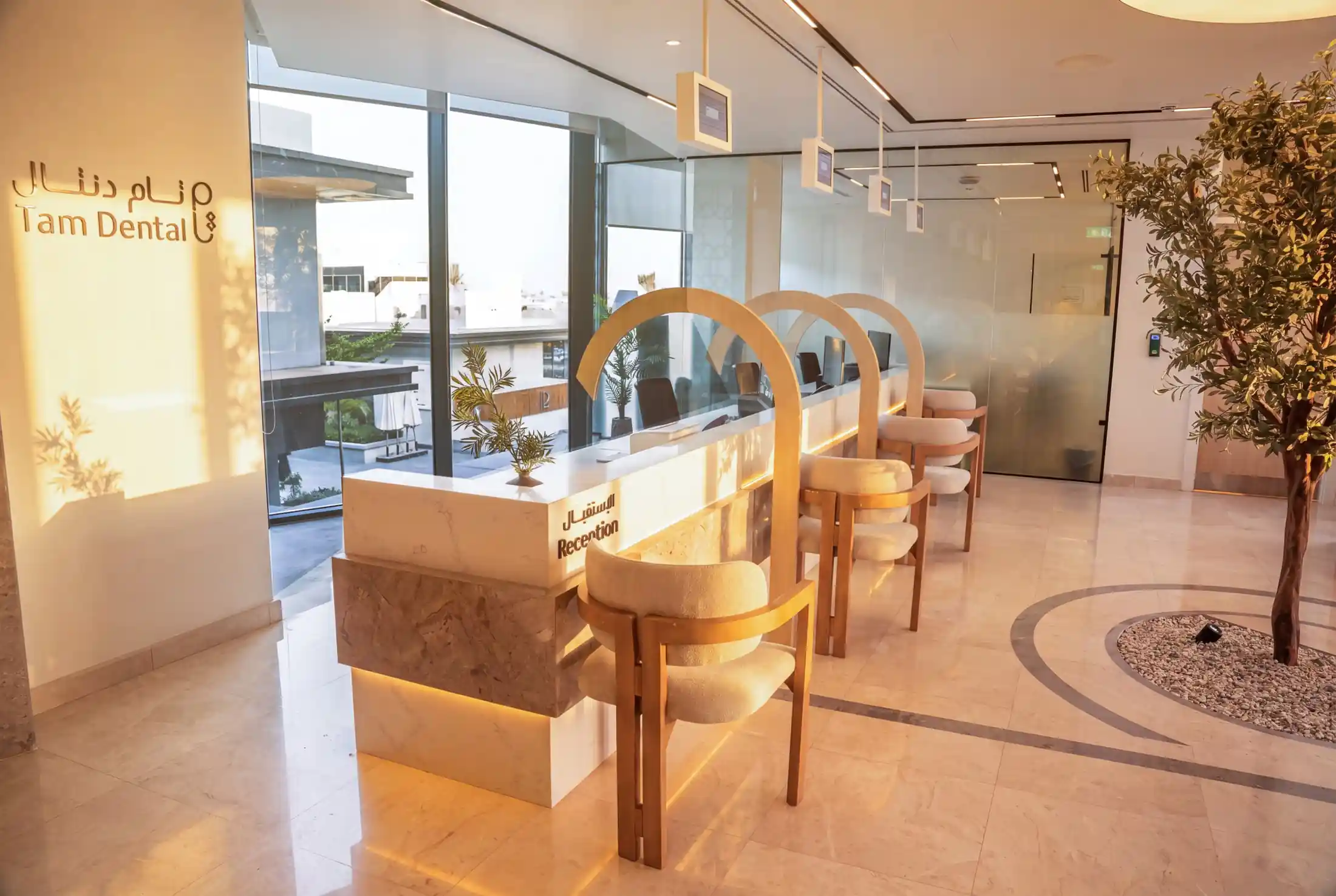
Tam Dental is an institutional dental clinic in Jeddah with more than 15 years of experience and over 5,000 patients. Our consultants trained at universities including Harvard, Boston University and the University of Toronto, and our team is multilingual. If you live in Jeddah or are new to the city, our guide for expats looking for a dentist in Jeddah covers the practical questions.
To book: request an online consultation with a discount, call 920033363, or visit one of our two branches in Al-Shati, Jeddah: Sari Street, or King Road in Al-Shasha Tower. If you have facial swelling or a fever, call first rather than waiting for a later appointment.
Frequently asked questions
Is there a Tam Dental branch in Makkah?
No. Tam Dental has two branches, both in the Al-Shati district of Jeddah.
Who can I call for medical advice in Makkah?
The Ministry of Health’s 937 call centre works 24 hours a day, in seven languages, and offers medical consultations by phone.³
What should I do if I knock out a tooth?
Hold it by the crown, rinse it briefly in milk or saliva if it is dirty, and try to put it back in the socket. If that is not possible, keep it in milk and see a dentist within the hour if you can.²
When is tooth pain an emergency?
Go to a hospital emergency department if the swelling spreads around your eye or neck, or makes it hard to breathe, swallow or speak.¹
Can painkillers fix a toothache?
They ease the pain, but they do not treat the cause. If pain lasts more than 2 days or painkillers do not help, see a dentist.¹
How do I check that a dentist in Saudi Arabia is licensed?
Use the Saudi Commission for Health Specialties’ online service to check whether a practitioner’s registration is valid. It is free and gives an instant result.⁵
Medically reviewed by: Dr. Moayad Alamri, Consultant in Family Dentistry (American Board of Comprehensive General Dentistry)
Sources
- NHS — Toothache — https://www.nhs.uk/conditions/toothache/
- NHS — Knocked-out tooth — https://www.nhs.uk/conditions/knocked-out-tooth/
- Saudi Ministry of Health — MoH: 937 Receives Over 1 Million Calls During Hajj 1447H (27 May 2026) — https://www.moh.gov.sa/en/Ministry/MediaCenter/News/Pages/news-2026-05-27-002.aspx
- Saudipedia — Haramain High Speed Railway — https://saudipedia.com/en/article/1136/government-and-politics/transport/haramain-high-speed-railway
- Saudi Commission for Health Specialties — Practitioner registration verification (service guide, Arabic) — https://scfhs.org.sa/ar/node/1992