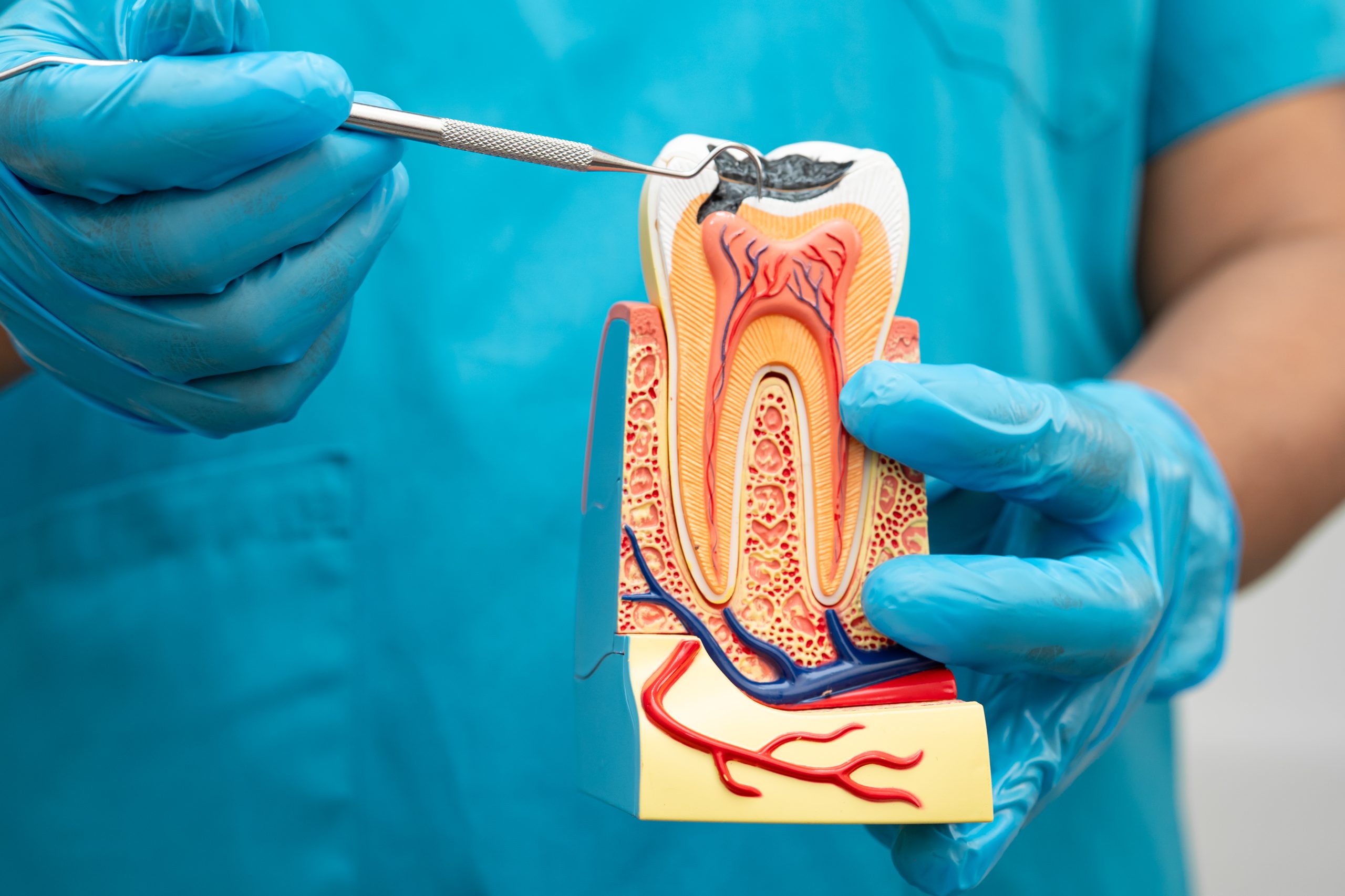
If you’re worried about having a root canal treatment because you’ve heard it’s painful, let’s be clear: the procedure itself is not painful, it is nearly the same as standard filling. In fact, it is designed to relieve the intense pain caused by an infected tooth pulp. At Tam Dental in Jeddah, our English-speaking specialists use the latest anesthesia and technology to make the process smooth and comfortable for foreign residents.
The real discomfort comes from the infection and inflammation of the tooth before the root canal is done—once the treatment begins, pain decreases rapidly. Studies show that pain intensity and duration fall significantly after treatment.
In this article we’ll walk you through what a root canal is, why and when it’s needed, how long any discomfort typically lasts, what the “most painful part” really is, and what to expect when you come in at Tam Dental for your evaluation and treatment.
What Is a Root Canal and Why Is It Needed?
When the pulp inside a tooth (which contains nerves and blood vessels) becomes infected — due to deep decay, a crack, or repeated dental work — the only way to save the tooth while eliminating pain and infection is to perform a root canal (endodontic treatment).
During the procedure, the dentist or endodontist removes the inflamed or infected pulp, cleans and disinfects the root canals, then fills and seals the space.
Thus, rather than being the cause of pain, root canal treatment often relieves pain from an infected tooth.
Why Do People Think a Root Canal Is Painful?
The idea that a root canal is extremely painful mainly comes from outdated experiences. Modern anesthesia, improved instruments, and guided techniques have made the procedure much more comfortable.
Still, patients may feel some pressure or vibration during treatment, but pain is very well controlled.
What’s the Most Painful Part of a Root Canal?
For most patients:
- During the procedure: Thanks to local anesthesia, you should feel little to no pain; you might sense pressure or vibration but not sharp pain.
- After the procedure: The most likely discomfort comes in the first 24-48 hours due to residual inflammation of the surrounding tissues (ligaments, bone) rather than the canal itself.
So the “most painful part” is typically the pre-treatment infection (if present) or the first day of healing, not the procedure itself.
How Long Is the Pain After a Root Canal?
Recovery timelines generally follow this pattern:
- Mild sensitivity or tenderness: first 2-3 days.
- Significant improvement: within a week for most patients.
- If discomfort lasts beyond 7-10 days or worsens, that may indicate a complication and you should consult your dentist.
It’s important to remember that every case is unique — the extent of infection, complexity of the root anatomy, and your overall oral health affect recovery.
How Long Does It Take to Do a Root Canal?
- Many root canal treatments can be completed in one visit, especially when straightforward.
- Some cases require two or more visits if there is severe infection, unusual anatomy, or need to place a crown afterwards.
- The actual time in the chair for a typical molar root canal may be 60-90 minutes depending on complexity.
Treatment Options & What to Discuss with Your Dentist or Endodontist
- If you have a badly decayed, infected or fractured tooth (permanent tooth) your dentist may refer you to an endodontist.
- Ask about whether your tooth can be saved with a root canal vs extraction (removal) followed by implant or bridge. The root canal preserves natural tooth and its alignment in your dental arch.
- Oral hygiene before and after treatment is crucial: good cleaning reduces risk of failure and helps healing.
- Check if crown coverage is needed after root canal (common) to protect the tooth long-term.
- For teeth with previous misalignment or orthodontic treatments, root canal success depends also on the tooth’s position and load in the mouth.
Professional Advice
- Don’t delay treatment: the pain you feel now may be from pulp infection. The root canal will resolve that infection far more comfortably than ignoring it.
- After treatment, avoid hard or crunchy foods on the treated tooth until fully restored — this helps prevent fracture or reinfection.
- Maintain good oral hygiene (brush, floss, avoid rampant tooth decay) to protect not only the treated tooth but the surrounding teeth and gum health.
- If you continue to feel throbbing pain, swelling, or sensitivity more than a week after treatment, contact your dentist. These may indicate complications.
FAQS
Is it painful to get a root canal?
Thanks to local anesthesia and modern techniques, the procedure itself is not more painful than a typical filling. Any soreness afterward is mild and temporary.
What’s the most painful part of a root canal?
The most painful part is often the infection before treatment or the first day of healing after. The procedure itself should be comfortable under anesthesia.
How long is the pain after a root canal?
For most patients the discomfort lasts 2-3 days and significantly improves within a week. If pain persists beyond this, get checked.
How long does it take to do a root canal?
A straightforward root canal may finish in one visit of about 60-90 minutes, though two visits may be required for complex teeth.
Do I still need a crown after root canal?
Often yes — after the root canal the tooth may be weaker. A crown protects it and helps maintain chewing function and alignment in the dental arch.